Morning Herald
Mariners' Museum, Uncurated Search Results
Type: Skipjack
Year: 1899
Builder:
Location: Fairmount

These records are found in the online catalog of The Mariners’ Museum and Park in Newport News, Virginia. Uncurated search results are presented to give researchers and interested readers an idea of whether the museum’s archives contain information about this vessel and whether it may be worthwhile to visit the museum’s catalog search page for further investigation. Uncurated results may be inaccurate or incomplete.
Search mode: Exact Name. Search phrase(s): "Morning Herald". Results returned: 7. Results displayed in this table: 7.
Use these buttons to send uncurated search results to your own app or text document for further research. First, check the box for any row, or click "Select All" then uncheck any rows. Then click "Show Selections". You can then copy your selections from the text box and past them into your app.
| Fetch? | Row ID | Media | Date | Vessel | Place | Related Places | Inscription/Marks | Subject | Notes | Archive Number |
|---|---|---|---|---|---|---|---|---|---|---|
| 1 | No image URL. | New York (N.Y.)–Newspapers | Title from caption. Description based on: Vol. 3, no. 1 (May 22, 1837). | LB85810 | ||||||
| 2 | No image URL. | New York (N.Y.)–Newspapers | Title from caption. Description based on: Vol. 1, no. 1 (Aug. 31, 1835)= whole no. [1]. | LB85805 | ||||||
| 3 | No image URL. | "Portions of the following pages have already appeared, in substance, in the columns of the Morning herald, of the 1st, 14th, and 26th of December last." Pref. | LB14690 | |||||||
| 4 | No image URL. | Australia. Royal Australian Navy | Great Britain–History, Naval. | Reprinted from the Sydney Morning Herald. | LB36451 | |||||
| 5 | 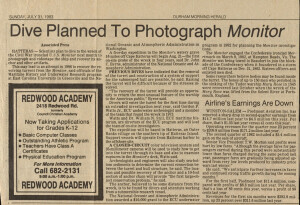 | 7/31/1983 | Monitor (Ironclad : 1862).; Mary Rose (Ship : 1511); East Carolina University. Program in Maritime Studies.; Merrimack (Frigate : 1856-1860). | Underwater archaeology–North Carolina–Atlantic Coast.; Antiquities–Collection and preservation. | Clipping of a one page article from the Durham Morning Herald. Announces that scientists plan to dive to the wreck of the Monitor to photograph, video tape, and recover its anchor and any other artifacts. The five day expedition is set to begin August 21st. Some researchers believe that they may find bones inside the turret like when the warship, Mary Rose, was lifted from the Solent River in Portsmouth, England. | MS0164.002/05-009.34#02 | ||||
| 6 | No image URL. | New York (N.Y.)–Newspapers | Title from caption. Description based on: Vol. 6, [no. 1] (Sept. 21, 1840) = [whole no.] 1565. | LB85820 | ||||||
| 7 | 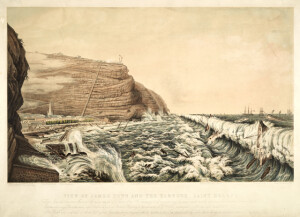 | SHORT DESCRIPTION: Colored lithograph of showing the town of Jamestown on St. Helena island and high waves carrying many vessels ashore. The picture has the caption: "Taken from the Harbour Master’s Office during the rollers of the 17th February 1846, on which day thirteen vessels (mostly captured slavers) were destroyed by the extraordinary phenomenon, and public as well as private property to the amount of £10,000 destroyed. It was also remarkable that the agitation of the water was confined to about 500 yards from the shore, beyond which distance the sea was perfectly calm, there being at the time scarcely any wind." The image was created from a drawing by Lt. Frederick Rice Stack. NOTES: Frederick Rice Stack was a soldier and artist. He became an ensign with the St. Helena Regiment on June 1, 1839. On January 7, 1842 he was promoted from Ensign to Lieutenant while serving with the 45th Foot. As a lieutenant in the St. Helena Regiment he was appointed captain on August 5, 1853 and served with the 65th Regiment of Foot. On December 26, 1865 while serving with the 37th foot he was appointed Major. He served as a Major Brigade at Auckland, New Zealand. NOTES: From the Sydney Morning Herald, Wednesday August 12, 1846, page 3. PARTICULARS RESPECTING THE LATE ROLLERS AT ST. HELENA. To the Editor of the St. Helena Gazette. SIR,-I do myself the honour to forward a few observations which I made on Tuesday, the 17th instant, as to the occurrences of the day, and should it be deemed worthy a place in the St. Helena Gazette, it will recompense me for the little time it has cost. I, however, earnestly hope, that the want of language adequate to express the grandeur, as well as the awfulness of what every spectator witnessed, will be in a measure atoned for by the accuracy of the statement. St. Helena has ever boasted of a safety of its roadstead, and that most justly, as no individual upon the island can remember a solitary instance of a vessel having been wrecked upon its shores. Those who witnessed the scene presented on Tuesday, the 17th instant, alas will have a different tale to tell. The roadstead, which only the day previous was like a mill pond, was on this day (Tuesday, 17th instant,) a sea of troubled waters. During Monday night, the rollers, for which St. Helena has ever been celebrated, the cause of which is altogether unaccounted for, began gradually to rise, and on Tuesday had increased to an awful height, like so many rolling mountains, one after the other, driving everything before them. The English schooner Cornelia, condemned at this port a short time since, and purchased by Mr. Cole, was the first vessel driven on shore, being, no doubt, not so securely moored as the other vessels, although in any other weather equally sage. If the person in charge of this vessel had been left five minutes longer than he was on board, it would have been out of the power of all human aid to have saved his life, as the vessel, some distance from the shore, was buried in the tremendous seas, and ultimately came in upon the beach : - in a few minutes she was a mass of splinters. Immediately after the Cornelia disappeared, the Brazilian brig Descobrador, (127 tons) brought to this island under the charge of Lieutenant Moynell, and condemned on the 15th January, 1846, as being fitted for the slave trade, as a prize to H.M. sloop Star, lifted her anchors and was driven by the force of the rollers on to the beach, between the drawbridge and upper crane ; the shipkeeper Robert Seale, his wife, and two other persons were on board at the time she touched. Sea after sea broke over the vessel, and she fell broadside on to the shore : the larboard shrouds ultimately gave way, and the lives of the poor creatures on board were in I imminent danger, not only by the vessel separating fast, and the seas rolling over, but by the falling of the masts. At this time two persons from on board swam to the shore, leaving the shipkeeper (Seale) and his wife holding on by the rail on the leeward side of the vessel, appealing to the numbers on shore, within hearing of them, for assistance. The Town Major endeavoured to convey a rope by means of a rocket to the vessel, but by some unforeseen circumstance it failed. Mr. Chatfield, master's assistant of M.M. sloop Flying Fish, attempted to swim off with a spar attached to a rope, and after arriving alongside of the vessel was taken by the sea under her counter, roller after roller breaking over him, which buried him for a time, and finally threw him on the beach in an exhausted state. A whale boat belonging to Mr. Rolfe was launched, in hopes of being taken alongside the vessel, but she was no sooner in the water than she was dashed to pieces. At this period an American seaman, named Roach, who has been upon the Island some time, and is employed as a boatman, most nobly plunged into the sea and swam to the vessel, which he reached in gallant style, taking with him a rope, the end of which was secured on shore. Upon gaining the deck he hauled on board a sufficiency of the rope, and after attaching the end which he took to the side of the vessel, to enable him to regain the shore, without depriving Seale of the means of escape, he then tied a rope round Mrs. Seale's body, and immediately plunged into the water, when they were dragged on shore by the spectators, amongst whom were Dr. Tweedale, of H.M. steam sloop Prometheus, and Lieutenant Grant, R.A., who plunged in to the assistance of Roach as he approached. The rollers having knocked him with Mrs. Seale over several times. Mrs. Seale was landed almost senseless, but prompt medical aid being afforded, she soon rallied, and was conveyed to her home about two hours after. Seale, when he saw his wife was safe, tied the rope round his waist, and was drawn on shore without sustaining any injury. From the time the Descobrador touched the rocks to the period of the people being taken out of her ten minutes could not have elapsed, and within five minutes afterwards she separated and went to pieces. The hand of Providence showed itself most conspicuously, for when the mast went even with the deck, it fell towards the shore, by which any number of persons could have saved themselves with common care and energy. However, those persons who witnessed the scene must, be fully satisfied that the saving of the lives of Robert Seale and his wife must be owing (with the aid of Divine Providence) to the exertions of Joseph Roach. The shipkeepers on board the other condemned slavers were immediately removed and conveyed on board of a vessel lying at anchor outside of the influence of the rollers. Whilst the Descobrador was on her beam ends upon the beach, the schooner, name and nation unknown, captured by H.M. steam sloop Prometheus, on the 22nd November, and condemned in the Vice-Admiralty Court on 20th December hist, parted from her anchors, and, as if propelled by steam, ranged herself on the outside of the Descobrador. This vessel was partly demolished, having been purchased by Mr. Stewart at auction. About 12 o'clock, the Brazilian schooner Acquilla with another prize, lifted their anchors and were driven upon the beach, in front of the town. The Acquilla remained perfect for some time, but the other very soon went to pieces. The Acquilla was detained by her H. M. sloop Cygnet, but the result of the seizure is as yet uncertain, as her case is defended. The vessel that broke adrift with the Acquilla was the Brazilian brigantine St. Domingos, captured by H.M steam sloop Prometheus, on the 25th of December, brought to this island by Mr. Clark, Naval Cadet, and condemned on the 2nd instant. About 1 o'clock, a tremendous heavy roller, which seemed determined to sweep away everything before it, broke over the Rocket hulk, which was lifted stern uppermost, and disappeared. This sea swept away the lower crane and verandah, the latter being placed some distance from the landing place against the hill, for the accommodation of captains of ships and others waiting at the wharf for boats. The crane was carried bodily by the sea into the Commissariat Coal Yard, a distance of fifty yards, where it now lies buried with rubbish and stone. Previous to this sea breaking over the verandah or balcony, a great number of persons had resorted there for the purpose of gaining a good view of this awfully interesting but magnificent scene ; but as a warning, a previous sea had washed in, and they fortunately took the hint, otherwise many must have been sacrificed, either by the falling of the building, or being taken away by the receding sea. Up to this hour almost every passage and luggage boat had been swept from their moorings-some thrown on shore and others taken out to sea. The Glacis in front of the fortifications, James' Town, impassable from the immense quantity of wood, masts, casks, bunks, and other materials, thrown up by the sea from the wrecked vessels. About 1 o'clock, the Brazilian schooner Eufrazia, captured by H.M. steam sloop Prometheus on 25th December, 1845, brought to this island for adjudication by Lieutenant Pollard, and condemned on the 29th January, and the Brazilian brigantine Esperanza, captured on 26th December, 1845, by H.M.S. Acteon, and brought to this island by Mr. Lowe, second master, condemned on the 29th January, were buried by a tremendous roller breaking over them ; the former disappeared in an instant, having sunk at her anchors ; the latter, after her masts went by the board, drifted out to sea, a total wreck ; and whilst off Munden's Battery was boarded by some of the merchant vessels' boats, when sails, spars, and other articles were removed. This vessel ultimately drifted out to sea. The rollers still continuing at an awful height, great fears were entertained for the safety of the English barque Lavinia, from Fernando Po, the crew of which vessel during the night previous had abandoned her, taking with them their chests and hammocks on board of a merchant vessel lying at anchor off the influence of the rollers. All communication with the shore and shipping was impossible, as it was dangerous for a boat to approach the landing place, much less to afford a communication. The fishing boats fortunately escaped, as they were all out during the night of Monday, and on Tuesday morning, finding it impossible to communicate, remained out, and received assistance from the different merchant vessels then riding at anchor in the Bay. About half-past five o'clock in the afternoon, the sea still continuing mountains high, the condemned Brazilian brigantine Julia, captured by H.M. sloop Star, was separated from her companion the Quatro de Marco, and thrown up by a succession of heavy rollers upon the West Rocks, and in an instant not a particle of her was to be seen. Almost immediately after, the Brazilian brig Quatro de Marco was, with four anchors down, lifted by the gigantic rollers, and, although buried for a time in the sea, was ultimately, by a heavy wave, lodged on the shore under Patten's Battery, near the West Rocks, the masts having been previously carried away by the force of the sea breaking over her. The Quatro de Marco was captured by H M. Sloop Cygnet, on the 18th December, 1845, and was brought to this island under the charge of Mr. Jones, Purser, on 26th December last, with 540 slaves. The remains of the hull of this vessel were sold on the 26th instant, by public auction, for £30 ; the greater part of her starboard side and the after part of the stern of this vessel were totally destroyed. Previous to her being thrown up to where she remained, she came in contact with an old anchor, which has been for nearly a century upon the projecting point of the West Rocks, and carried it away. Thus ended the scenes of this memorable day, a day that will ever be remembered by all who witnessed what took place. In addition to the vessels already stated, there were three other condemned slave vessels in the act of being broken up washed ashore. The loss of the boats has thrown many out of employment, and deprived them of their little all and the means of supporting their families. Thus, after the savings of many a hard day's toil they are deprived of a living ; but God's will be done ! and what has this day bean experienced only reminds us of our frail state, and how little we ought to think of our earthly possessions. The most painful part to be recorded of what this day has brought forth, is the loss of three of our fellow-creatures, who have met with a watery grave, and summoned, it is to be feared, in an unprepared state, to appear before their Maker. On the evening previous, John Maggott, an old and experienced rock fisherman, with James Craig, a shoemaker, and Robert Bath, went to the rock under Sugar Loaf, in a boat for the night. At this season of the year many persons are induced to enjoy this sport, being invited by what is termed upon this island, "Bulls-eye fishing," a delicate fish which abounds during the months of January, February, and March. The rock under Sugar Loaf has always been celebrated for the abundance of this description of fish, and being near the town it is accessible by a very narrow path, and with the assistance of a rope to descend, affords the means of escape in the event of the sea suddenly rising. On this night Henry Trim and others, when the sea became rough, made their escape and returned home ; not so with Maggott, Craig, and Bath, who were separated by a small cove, and although in sight of the others, had no means of saving themselves, or those opposite rendering the slightest assistance. The boat that had landed these three poor creatures the evening previous, called according to promise on this morning, and although within hailing distance dared not venture too close. The boatmen were informed that Maggott had been swept away about five o'clock, and they, Craig and Bath, said-“we must soon follow." The circumstances of these poor creatures being in this perilous state was soon known in town ; a boat was immediately at a great risk despatched, and Mr. H. Doveton went by land with ropes, in order to descend to where they were last seen, and, at the hazard of his life, to endeavour, if possible, to save them ; but they were gone, and no more to be seen ! Bath has been for the last ten years cook to Mr. Solomon, and for eight years previous, cook to General Dallas, Governor of the island. He has left a widow with seven children to lament his untimely end. There were other persons who, during the night of Monday and all this day and night, were prevented returning to their homes in consequence of the unprecedented heavy sea. The Wharf, from the lower steps to the drawbridge, together with the Glacis, is almost 1 totally destroyed. The Commissariat coal yard, which was erected at a heavy expense in 1831 by General Dallas, also the iron tank under the verandah upon the wharf, for the supply of water to shipping, totally destroyed. The fortifications at Lemon Valley much injured ; and great damage sustained at Rupert’s where the Liberated Africans are located. To attempt- to give a correct idea of the violence of the rollers on this eventful day is impossible, but as this humble effort towards n description of the same may meet the eye of many who have spent happy years upon the Old Rock, and are now in England and elsewhere, they will be enabled to judge of what I am at a loss fully to describe, and I will simply close by stating that the sea rolled as far as the officers' quarters at Rupert's, and that a 24-pounder carronade was taken from its platform from the Lower Chubbs Battery into the sea, as well as destroying the parapet on both sides. A boat was also drifted from James's Bay to the extreme point of the island to windward, Deep Valley, where it is now to be seen a wreck. The wind for many days previous to the setting in of the rollers, was from the northward and westward, with close sultry weather. The property lost by individuals, together with the expense of repairing the wharf, coal-yard, &c, is estimated at upwards of £20,000. St. Helena, 27th February. 1846. NOTES: In the article “The Geology of Saint Helena Island” by Reginald A. Daly, published in Proceedings of the American Academy of Arts and Sciences , Mar., 1927, Vol. 62, No. 2 (Mar., 1927), pp. 31-92. The author states on page 35 that St. Helena’s rollers are attributed by hydrographers principally to major storms in the North Atlantic. In the article “An Example of North Atlantic Deep-Ocean Swell Impacting Ascension and St. Helena Islands in the Central South Atlantic” by J. M. Vassie; P. L. Woodworth; and M. W. Holt, published in the Journal of Atmospheric and Ocean Technology, Volume 21, Issue 7, July 2004, pages 1095-1103 it is reported that in 1999 tide gauges at Ascension and St. Helena Islands recorded an example of unusually large deep-ocean swell. A study of the numerical wave model output indicated the swells were actually generated by the remains of Hurricane Irene in the North Atlantic one week earlier. See the object file for a copy of the full study. NOTES: Jamestown sits on the north side of St. Helena facing a huge expanse of the Atlantic Ocean. The anchorage in front of the town is from 8 to 25 fathoms deep. The town lies between two large hills, Mundens on the east and Ladder Hill on the west, both are fortified with cannon. There is a fort on Ladder Hill that contains barracks and quarters for the military establishment. It is connected to the town by a ladder of seven hundred steps while a carriage road zig-zags up the steep hill. A signal station sits at the top of the ladder. The town’s sea-facing side is protected by a well-built curtain wall. A road from the landing steps of the wharf, bordered on the land side by a deep moat, leads over a moated drawbridge through an arched portcullised gateway onto a spacious square called the lower parade. The chief building off the square is the Fort (Fort James) or Castle. ADDITIONAL INFORMATION: SEE: St. Helena: The Historic Island, from its Discovery to the Present Date, By E. L. Jackson, published in London by Ward Lock & Co. Ltd., New York and Melbourne, 1903. Pages 250-258. SEE: 'Disasterous Effects of the Rollers at St. Helena," The Nautical Magazine and Naval Chronicle, June 1846, pages 322-324. | CL18816 |
Created 2026 by Don Barker, CBMM volunteer, for the Chesapeake Shipbuilding Project. shipbuilding@sailingworkboats.es